Morocco Travel Blog · 18 min read
Marrakech Travel Guide 2026: Everything You Need to Know (By Locals Who Live Here)
The complete Marrakech guide written by a Casablanca-based team that handles hundreds of Morocco road trips per year. Is Marrakech worth it in 2026? Honest answer. Best neighborhoods, souks strategy, where locals actually eat, how to survive Jemaa el-Fnaa, Marrakech vs every other Moroccan city, and the World Cup 2030 angle nobody else is covering.
By Omar L. — Casablanca Local & Morocco Road Trip Specialist · Published August 10, 2026 · Updated August 10, 2026
Marrakech is Morocco's most visited city, its most photographed city, and — depending on who you ask — either its most exciting or its most exhausting. Our team has sent hundreds of clients to Marrakech from Casablanca Airport over the past five years. We know what they loved, what overwhelmed them, what they wish someone had warned them about, and what most travel guides get wrong. This is the Marrakech guide we give our own clients before they set off on the A7 motorway. Honest, practical, written by people who live in Morocco — not bloggers passing through for three days.
Is Marrakech Worth Visiting in 2026? The Honest Local Answer
Yes — but with clear expectations. Marrakech is one of the most sensory-intense cities on earth: a UNESCO-listed medina where 1,000 years of history collides with 21st-century tourism, where the call to prayer competes with snake charmers, and where the world's most theatrical public square runs on chaos that somehow works. It is extraordinary. It is also, at times, exhausting.
The travelers who love Marrakech are those who engage with it on its own terms: who slow down in the souks, who accept that getting lost is the point, who eat where locals eat rather than where the signboards say "Tourist Menu", and who understand that the vendor pressure they'll encounter is part of a centuries-old commercial culture — not a personal attack.
The travelers who leave disappointed are usually those who expected a sanitized, Instagram-curated version of Morocco. Jemaa el-Fnaa at midnight is spectacular. The same square at 2pm in August with 50 tour groups is something else. Marrakech rewards preparation. This guide is that preparation.
Marrakech Quick Facts 2026
Everything you need to know before arrival — the practical facts most guides bury in paragraph 15.
| Fact | Detail |
|---|---|
| Official name | Marrakech (مراكش) — also spelled Marrakesh |
| Nickname | "The Red City" (walls and buildings made of local red sandstone) |
| Population | ~1 million city, ~4 million metro |
| Location | Foothills of the High Atlas Mountains, 240 km south of Casablanca |
| Airport | Marrakech Menara Airport (RAK) — 6 km from medina |
| Nearest major airport | Casablanca CMN — 240 km, 2h30 by motorway |
| Currency | Moroccan Dirham (MAD) — 1 EUR ≈ 10.8 MAD (2026) |
| Language | Arabic (official), Darija (local dialect), French, English in tourist areas |
| Best time to visit | March–May and September–November (perfect weather, manageable crowds) |
| How many days needed | 3 nights minimum — 4–5 for day trips (Atlas, Essaouira, Agafay) |
| World Cup 2030 | Marrakech is a host city — stadium renovation underway (closed until 2029) |
| Car rental from CMN | From 250 MAD/day (€23) — MoroccoForYou Cars, meet & greet at arrivals |
The Marrakech Medina — How to Actually Navigate It
The Marrakech medina is a UNESCO World Heritage Site and one of the largest car-free urban areas in the world. It is also deliberately disorienting — the narrow derbs (alleyways) were designed to confuse invaders, and they do an equally effective job on tourists. Here is what you need to know to navigate it without losing your mind.
The medina is divided into roughly four quadrants by two main axes: the north-south axis connecting Jemaa el-Fnaa to the Mellah (Jewish quarter), and the east-west axis through the main souk district. Jemaa el-Fnaa is the orientation point — if lost, ask any local for "la place" and you will be pointed in the right direction.
The souks are organized by craft — a medieval organizational system that survives intact. Dyers near the tanneries, spice sellers in the spice souk, leather workers near Chouara, woodworkers near the Medersa Ben Youssef. Walking with this map in mind transforms the apparent chaos into a logical city.
Jemaa el-Fnaa — The World's Most Theatrical Square
Jemaa el-Fnaa is the beating heart of Marrakech and one of the most extraordinary public spaces on earth. UNESCO recognized it not as a monument but as an "Intangible Cultural Heritage" — acknowledging that what makes it special is not what is built there but what happens there: daily. Snake charmers, acrobats, storytellers, henna artists, orange juice vendors, musicians playing Gnawa trance music, food stalls that materialize at dusk and fill the square with smoke and the smell of grilled meat.
The square operates on a rhythm. Morning: quiet, locals and juice vendors. Afternoon: tour groups, heat, controlled chaos. Sunset: the transformation begins — stalls appear, musicians arrive, the crowd thickens. After 9pm: the square reaches its peak theatrical intensity, with dozens of food stalls, hundreds of performers, thousands of visitors and locals all sharing the same space. This is when Jemaa el-Fnaa becomes something genuinely unrepeatable.
Best Things to Do in Marrakech — The Essential List
Beyond Jemaa el-Fnaa, Marrakech has more depth than most visitors discover in a standard 48-hour visit.
| Attraction | Area | Time needed | Price | Local tip |
|---|---|---|---|---|
| Jemaa el-Fnaa | Medina centre | Evening — 2+ hours | Free to enter | Go at 9pm for peak atmosphere |
| Majorelle Garden + Yves Saint Laurent Museum | Gueliz | 1.5–2 hours | MAD 150–200 | Book online — queues otherwise. Best early morning. |
| Bahia Palace | Southern medina | 1 hour | MAD 70 | One of Morocco's finest 19th-century palaces — often overlooked |
| Saadian Tombs | Southern medina | 45 min | MAD 70 | Book timed entry — crowds get intense 10am–2pm |
| Medersa Ben Youssef | Northern medina | 1 hour | MAD 70 | Most beautiful Islamic architecture in Marrakech — go early |
| El Badi Palace ruins | Southern medina | 1 hour | MAD 70 | Atmospheric ruins — best in late afternoon light |
| Mellah (Jewish Quarter) | Southern medina | 1 hour | Free | Authentic and largely tourist-free — the real Marrakech |
| Rahba Kedima (Spice Square) | Medina souks | 30 min | Free | Buy spices here — better quality and authenticity than tourist shops |
| Koutoubia Mosque gardens | Near Jemaa el-Fnaa | 30 min | Free (gardens only) | Non-Muslims cannot enter mosque — gardens are beautiful at sunset |
| Le Jardin Secret | Northern medina | 1 hour | MAD 50 | Underrated — a restored 16th-century riad garden with rooftop view |
| Agafay Desert | 40 km from medina | Half to full day | MAD 400–1,200 (tours) | Rocky desert — different from Sahara but closer and equally beautiful |
| Atlas Mountains day trip | 60–90 km from medina | Full day | MAD 200–400 (transport) | Hire a car at CMN or Marrakech — public transport is slow |
The Marrakech Souks — A Practical Guide
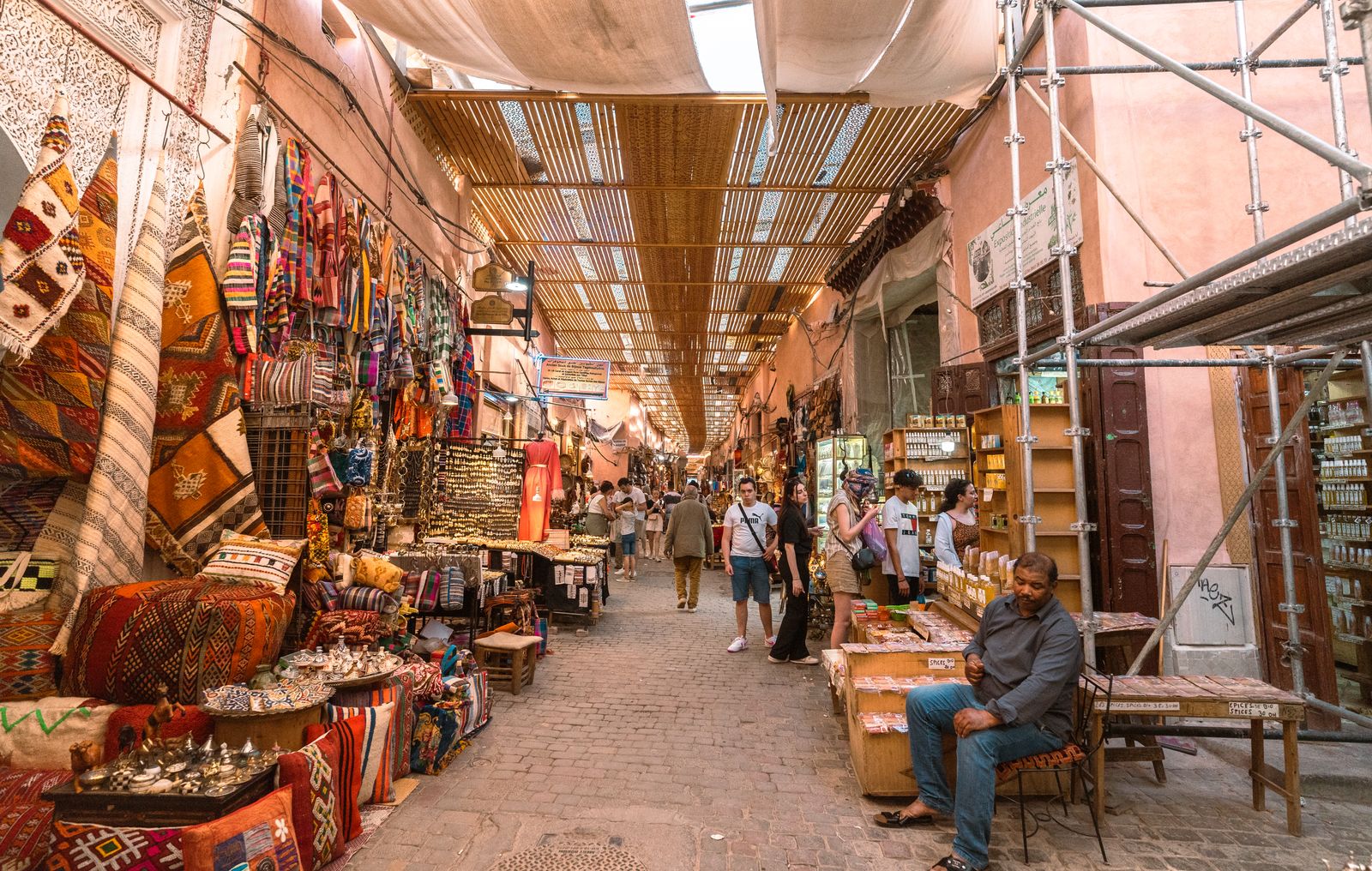
The souks of Marrakech are one of the most intense shopping experiences on earth — and one of the most rewarding if you approach them correctly. The key to surviving and enjoying the souks is understanding that everything is a negotiation, that the first price is always the opening bid, and that the appropriate counteroffer is approximately 40–50% of what you are first quoted.
The souks are organized by trade: the Souk des Babouches (leather slippers), Souk des Teinturiers (dyers), Souk Haddadine (metalworkers), Souk Cherratine (leather goods), and the main Souk Semmarine that runs north from Jemaa el-Fnaa. Walk the full souk route before buying anything — prices and quality vary dramatically between stalls selling identical items.
| Item | Best souk | Fair price range | Tip |
|---|---|---|---|
| Babouches (leather slippers) | Souk des Babouches | MAD 80–150 (€7–14) | Genuine leather vs synthetic — leather has a distinctive smell |
| Argan oil (culinary) | Spice souk / Rahba Kedima | MAD 150–250/250ml (€14–23) | Buy from women's cooperative for guaranteed authenticity |
| Argan oil (cosmetic) | Same as above | MAD 100–180/100ml (€9–17) | Test: cosmetic is golden, culinary is darker |
| Wool blanket (handira) | Northern medina | MAD 400–800 (€37–74) | Machine-made vs handwoven — handwoven is heavier, irregular |
| Ceramic tagine | Pottery souk (south medina) | MAD 150–400 (€14–37) | Lead-free ceramics are marked — ask specifically |
| Silver jewellery | Souk Semmarine | MAD 100–500 (€9–46) | Genuine silver has 925 or 800 stamp — check before buying |
| Leather bag | Souk Cherratine | MAD 200–600 (€18–55) | Full-grain leather is stiffer than bonded leather |
| Spices (cumin, ras el hanout, saffron) | Rahba Kedima spice square | MAD 20–80 for 100g (€1.85–7.40) | Saffron fraud is common — genuine saffron is MAD 150+/gram |
Where to Stay in Marrakech — Riad vs Hotel
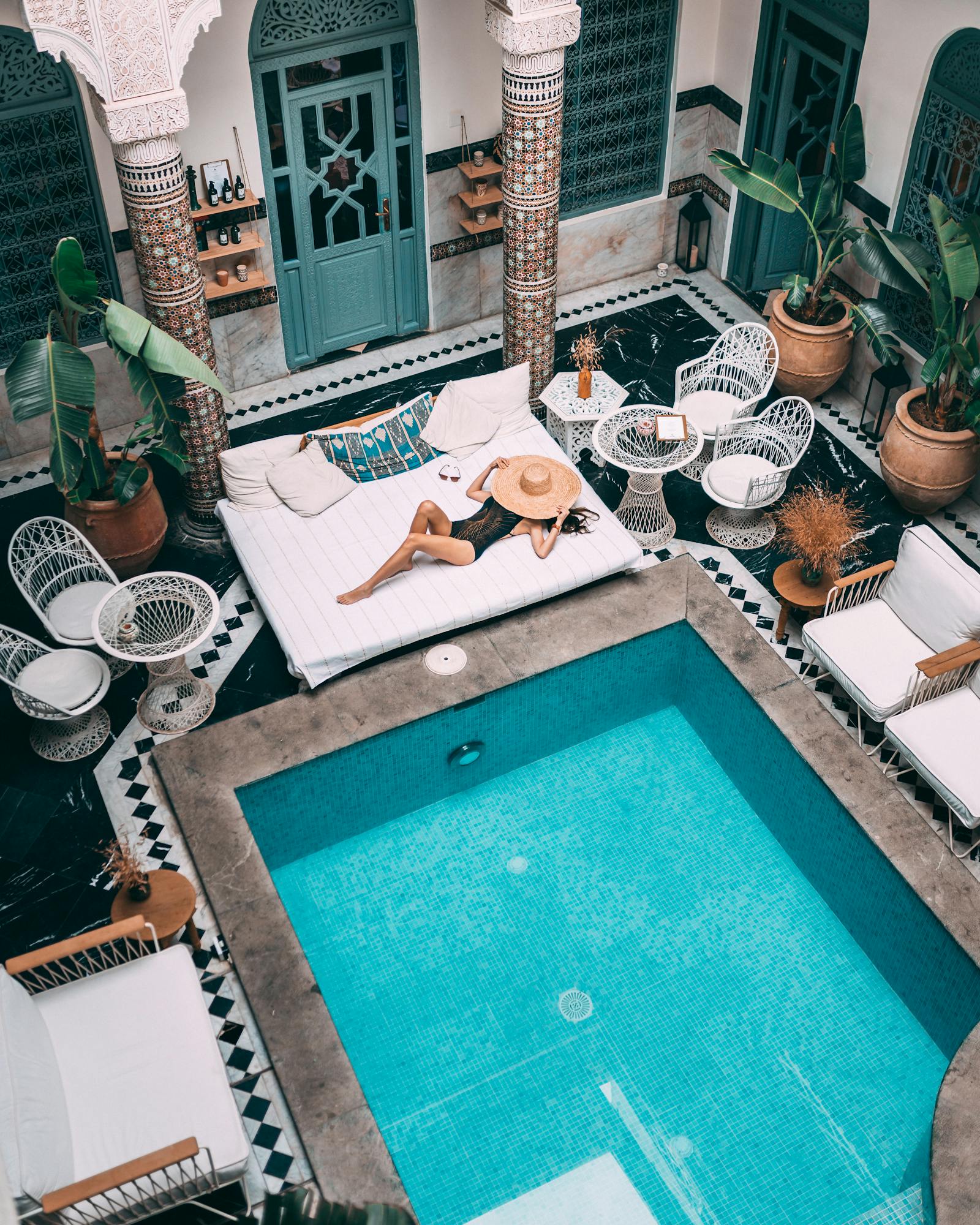
Marrakech invented the riad hotel concept — a traditional Moroccan house built around a central courtyard, converted into a boutique guesthouse. Staying in a riad inside the medina is the definitive Marrakech experience and should be the default choice for first-time visitors. The contrast between the chaos of the derbs outside and the serenity of your riad courtyard is one of the most memorable experiences Morocco offers.
| Area | Vibe | Best for | Price range/night |
|---|---|---|---|
| Medina (central riad) | Authentic, atmospheric, immersive | First-timers, couples, cultural experience | MAD 400–2,500 (€37–230) |
| Medina (budget riad) | Basic but charming, rooftop terrace | Solo travelers, budget, backpackers | MAD 150–400 (€14–37) |
| Gueliz (ville nouvelle) | Modern, restaurants, less chaos | Repeat visitors, business, longer stays | MAD 300–1,500 (€28–139) |
| Hivernage | Luxury hotels, swimming pools, quiet | Families, luxury seekers, pool priority | MAD 800–5,000+ (€74–460+) |
| Palmeraie (palm grove) | Resort vibe, space, nature | Honeymoons, families, resort holiday | MAD 1,200–8,000 (€111–740) |
What to Eat in Marrakech — Where Locals Actually Go
Marrakech has two food scenes running in parallel: the tourist restaurant circuit (menus in five languages, belly dancer shows, overpriced pastilla) and the real Marrakchi food culture that locals navigate daily. Both are valid. But if you only eat at one category, eat at the second.
| Dish | Where to find it | Price | Notes |
|---|---|---|---|
| Lamb tagine with prunes & almonds | Medina restaurants, riads | MAD 80–150 | The definitive Marrakchi tagine — slow-cooked 4+ hours |
| Couscous (Friday specialty) | Local restaurants, Fridays only | MAD 40–80 | Traditional Friday meal — seven vegetables on top |
| Msemen (square flatbread) | Street stalls, morning | MAD 3–5 | Flaky breakfast bread — eat with honey and argan oil |
| Harira (soup) | Street stalls, everywhere | MAD 5–10 | Morocco's national soup — tomato, lentil, chickpea |
| Merguez (spicy sausage) | Jemaa el-Fnaa night stalls | MAD 30–50 | Grilled on the spot — order by pointing |
| Pastilla (pigeon pie) | Traditional restaurants | MAD 60–120 | Sweet-savoury pastry — one of Morocco's great dishes |
| Mechoui (slow-roasted lamb) | Mechoui Alley, medina | MAD 60–100/portion | Whole lamb slow-roasted in underground ovens — line up before noon |
| Fresh orange juice | Jemaa el-Fnaa, everywhere | MAD 4–5 | The world's best value — squeeze it yourself at the stall |
| Mint tea | Every café | MAD 10–20 | Order "without sugar" (bla sukkar) if you prefer — then add your own |
Marrakech vs Other Moroccan Cities — The Honest Comparison
The most common question we get from clients is "which Moroccan city should I prioritize?" Here is our honest answer — city by city.
| City | Best for | Different from Marrakech because... | Visit if you... |
|---|---|---|---|
| Fes | Medieval depth, craftsmanship, authentic medina | Older, quieter, more inward — the world's best-preserved medieval city | Want fewer tourists, more history, deeper cultural immersion |
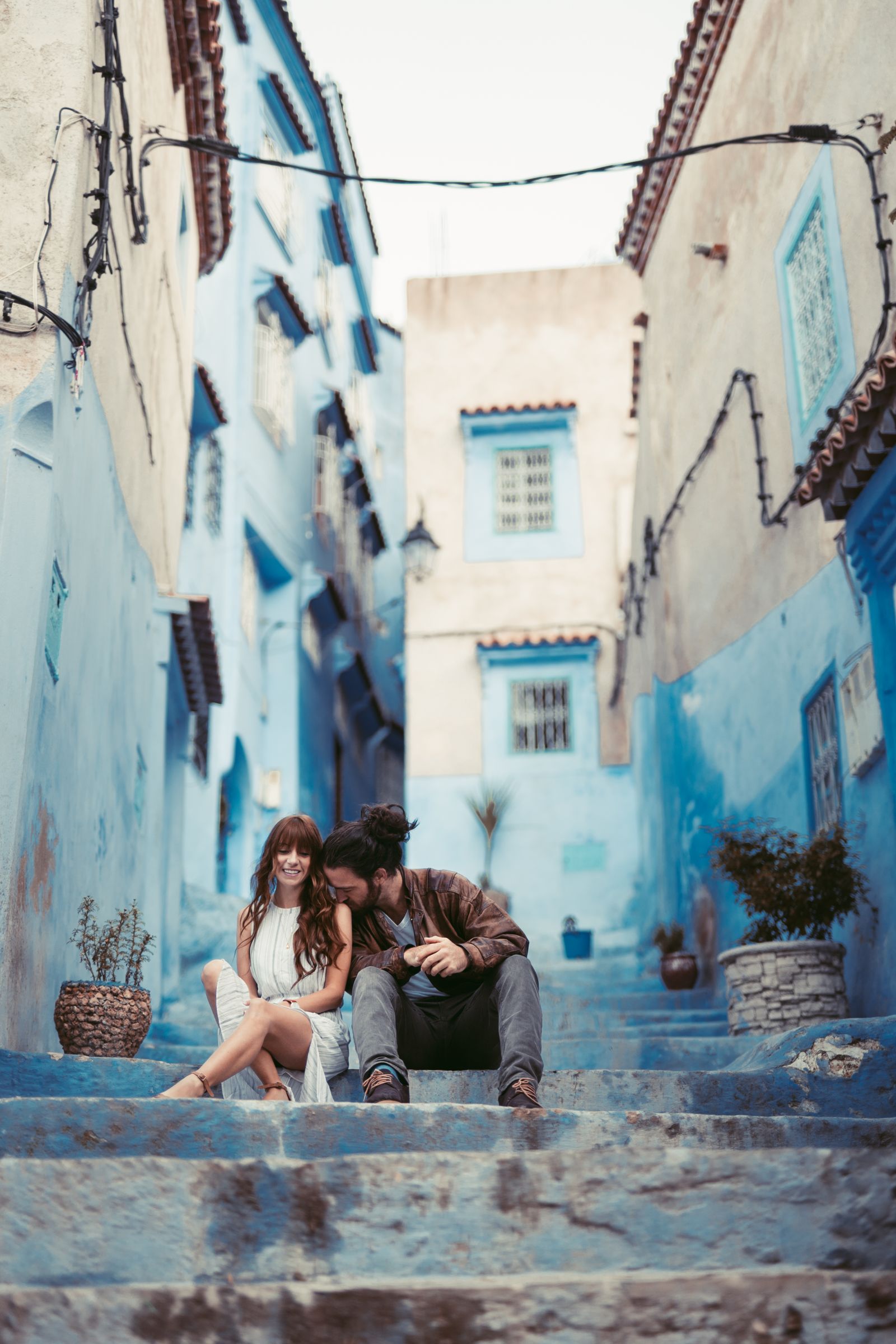
| Chefchaouen | Photography, mountain atmosphere, relaxation | Blue city in the Rif Mountains — completely different aesthetic and pace | Want beautiful photos, calm pace, mountain air, and cooler temperatures |
| Casablanca | Modern Morocco, nightlife, Atlantic coast | Morocco's business capital — modern boulevards, not a traditional medina | Want cosmopolitan Morocco, great restaurants, beach, and Hassan II Mosque |
| Agadir | Beach holiday, resort, surfing | Modern beach resort — rebuilt after 1960 earthquake, no historic medina | Want a beach holiday alongside your Morocco cultural experience |
| Essaouira | Coastal atmosphere, wind, relaxation | Atlantic port city — laid-back, Gnawa music, strong wind, excellent seafood | Want to decompress after Marrakech's intensity (perfect 2-day detour) |
| Sahara/Merzouga | Desert experience, camels, stargazing | Not a city — a landscape destination requiring 2+ days | Have 8+ days and want the full Morocco road trip experience |
| Rabat | Capital city, Roman ruins, quieter medina | Administrative capital — more European feel, excellent museums, calmer | Want Morocco without the tourist pressure of Marrakech or Fes |
Day Trips from Marrakech — Why You Need a Car
Marrakech's location at the foot of the High Atlas Mountains makes it one of Morocco's best bases for day trips. The range of landscapes reachable in a single day is extraordinary: from Atlantic coast (Essaouira, 2.5 hours) to mountain village (Imlil, 1.5 hours) to rocky desert (Agafay, 45 minutes) to waterfalls (Ouzoud, 3 hours).
| Destination | Distance | Drive time | Why go | Car needed? |
|---|---|---|---|---|
| Agafay Desert | 40 km | 45 min | Rocky desert landscape, quad bikes, glamping, close substitute for Sahara | Yes — essential |
| Imlil & Atlas Mountains | 60 km | 1h15 | Berber village, hiking, Toubkal National Park, snow in winter | Yes — mountain roads |
| Ouzoud Waterfalls | 170 km | 2h45 | Morocco's most spectacular waterfalls, swimming, Barbary macaques | Yes — most flexible |
| Essaouira | 190 km | 2h30 | Atlantic port, blue boats, Gnawa music, seafood, wind | Yes or bus (3h30) |
| Aït Ben Haddou | 200 km | 3h | UNESCO kasbah, filmed in Game of Thrones, Gladiator, Lawrence of Arabia | Yes — combine with Ouarzazate |
| Ouarzazate | 210 km | 3h15 | "Hollywood of Africa" — Atlas Studios, Taourirt Kasbah | Yes — combine with Aït Ben Haddou |
| Casablanca | 240 km | 2h30 | Hassan II Mosque, Corniche, Morocco's best restaurants | Yes or train (3h) |
Best Time to Visit Marrakech
Marrakech's location at the edge of the Sahara gives it one of Morocco's most extreme climates — scorching summers and cold winter nights, with two perfect windows in spring and autumn.
| Period | Temperature | Crowds | Verdict |
|---|---|---|---|
| March–May | 20–28°C, sunny, occasional rain | Medium — growing | ⭐ Best season — perfect weather, Agafay blooms, manageable crowds |
| June–August | 35–45°C at peak, very dry | High (international tourists) | Too hot for comfortable sightseeing 11am–4pm — swim and rest in riad |
| September–October | 25–32°C, excellent | Medium — declining | ⭐ Second best season — warm, post-summer calm, golden light |
| November–February | 15–20°C day, 5–10°C night | Low (budget season) | Good for sightseeing — bring layers for evenings, Atlas snow possible |
| Ramadan (variable) | Any weather | Local festival atmosphere | Restaurants closed daytime — souks quieter morning, busier evening |
| Eid holidays | Any weather | Very busy domestically | Higher riad prices — book well in advance |
Marrakech and the 2030 World Cup
Marrakech is one of six Moroccan cities selected to host matches at the 2030 FIFA World Cup, shared between Morocco, Spain, and Portugal. The Grand Stade de Marrakech (capacity approximately 46,000 after renovation) is currently closed for full renovation — the athletics track is being removed, stands are being brought closer to the pitch, and the entire venue is being upgraded to FIFA 2030 standards.
The renovation is expected to be completed by 2028–2029. For travelers visiting Marrakech before the World Cup, this means the stadium is not accessible for visits but the city is actively investing in infrastructure — roads, hotels, and public spaces are all being upgraded. The period 2026–2029 is optimal for visiting Marrakech before World Cup crowds and price inflation arrive.
For those planning to attend World Cup 2030 matches: Marrakech is 2h30 from Casablanca (motorway) and 3h from Fes. Renting a car at Casablanca Airport (CMN) and driving between host cities is the most flexible option for the tournament.
Marrakech Travel Tips — What Nobody Else Tells You
Ten things our clients wish they had known before arriving, based on hundreds of Marrakech road trips from Casablanca.
- The medina is intentionally disorienting — getting lost is part of the experience, not a failure. Download maps.me offline before arriving.
- Photographer scams: anyone who positions themselves between you and a landmark for a photo will ask for money. This is standard — pay MAD 10–20 or decline before they move.
- Henna scam: women who approach you to "draw a little henna for free" will demand MAD 200+ when finished. Nothing is free in the medina — agree a price before accepting anything.
- Fake guides: men who approach saying "the palace is closed today, I know another way" are never telling the truth. The palaces are open. Walk away.
- Taxi in Marrakech: petit taxis (red) must use meters. Always insist on the meter ("compteur s'il vous plaît"). If refused, get another taxi. Fixed-price taxis from the medina to Gueliz should be approximately MAD 30–50.
- The best hammam experience is not the one your riad recommends (they get commission). Ask for local recommendations — Hammam Dar el-Bacha is one of the most beautiful traditional hammams in Marrakech (MAD 100–150).
- Mechoui Alley for lunch — line up by 11:30am. By 1pm the best cuts are gone. Order by weight and point at what you want.
- Majorelle Garden: book tickets online the day before. Walk-up queues in high season can be 45–60 minutes. The Yves Saint Laurent Museum combined ticket (MAD 200) is worth it.
- The medina at night is safe and completely different from daytime — the vendor pressure drops dramatically after dark. The best time to walk the souks is 7–9pm when locals are shopping.
- Marrakech in summer (July–August) requires a riad with a pool or air conditioning. Do not book a riad with "natural ventilation" for summer — it means no air conditioning, and temperatures reach 40°C+.
Plan your Morocco trip with us
MoroccoForYou is a Morocco-based agency. Tell us your dates on WhatsApp — we reply within an hour with a draft itinerary, hotel options and a car or driver quote.